
Algebra 1.1
Course DescriptionThis course introduces the basic concept of Algebra. The first reaction of any student while getting introduced to Algebra is apprehension! Apprehension of using letters in Mathematics, apprehension of finding an ‘unknown’, apprehension towards what they assume, or have been told that this is a very complicated field of mathematics! This course is intended to remove this fear from you and help you get the true essence of Algebra and be able to actually enjoy it.
Algebra 1.1 – Units & Links
- The Unknown↓
- Unit I – Algebraic Expressions: An introduction↓
- Unit II – Algebraic Expression: Variables, Constants and Coefficients↓
- Unit III – Algebraic Expressions: Like terms in multi variable expressions↓
- Unit IV – Algebraic Expression: Finding the value of an expression↓
- Unit V – Algebraic Expression – Simplifying↓
The Unknown!
With so many inventions and discoveries, ‘x’ is still an unknown!!!
What is so special and scary about this letter? Isn’t it simply that it is ‘not known’ and we have to ‘find’ it?! Algebra sums up to just that – find something that you don’t know, with what you do know. We do not realize that we are actually using algebra in our everyday life.
When you go to the shop with 100 bucks and for this amount the shop keeper gives you 10 chocolates, you immediately get an ‘unknown’ here – which is the rate of each chocolate. It is so easy for you to find that one chocolate should have cost 10 bucks. So, you did not know how much one chocolate costed but what you knew was how much 10 chocolates costed.
When this is interpreted into mathematical terms, we give a name to this ‘cost of one chocolate’ as ‘x’ and say that 10\text{ times }x gives 100.
And mathematically, this is written as 10x=100. Now comes the scary part: Find x!
It was so easy when we did it mentally in the shop!! But why is it so scary when done in mathematical way? Can we use our mental calculation for any situation? How is Algebra going to help in finding many unknowns in the world? We will be looking into these questions in the following sections.
Now, let’s consider another situation where you see algebra:
Now, what is the problem? How much had the friend brought and how much he thought he had brought? Can’t we see a nice algebra question here?
Obviously, you had distributed 30 sweets since, it is 3 sweets times 10 students. And your friend thought he had 3 sweets times 20 students which would be 60 sweets. Yes? That’s Simple!
Now if I bring this to mathematics: I have some ‘unknown’ number of sweets which was given to 10 people with one person getting 3 pieces. If we give the name ‘x’ to the ‘unknown’ we have x sweets divided into 3 sweets each, you can find the number of friends who got the sweets.
That is, \frac{x}{3}=10 and …this is Algebra! And we can find the culprit ‘x’…!
↑ Back to topUnit I – Algebraic Expressions: An introduction
Now that you are comfortable with the word ‘Unknown’, let us continue our journey into the actual Algebra. Here is a small activity that would make you understand what is an Algebraic Expression. A minimum of two participants are needed to do this activity.
Click on the link below to download the activity.
From the above activity, you should have understood how to create an algebraic expression.
Check your understanding
- A basket contains ‘n’ number of flowers. What is the algebraic expression that would describe 5 such baskets with 2 extra flowers?
- A box of pencil has ‘p’ number of pencils. What is the algebraic expression that would describe 8 of such full boxes with 5 extra pencils?
- A bag contains some number of plastic balls. What is the algebraic expression that would describe 15 such bags with 8 extra balls? (Note: In this question the letter for the number of balls in each bag is not given. You need to assign a letter by yourself and create the expression)
- What is the algebraic expression for 20 boxes of coke bottles with 17 extra bottles of coke, where, each box contains same number of coke bottles?
- Create an appropriate situation for the algebraic expression 10t+2.
- What does 25x+4 mean?
- How would you describe the expression 8m-3?
- Which of the following could be expressed mathematically as an algebraic expression in the form ax+b?
a. I have 16 kgs of apples with extra 3 kgs of apples.
b. I have 16 kgs of apples with extra 3 apples.
Click below to see the solutions to the above questions:
Solution to “Check your understanding”
Unit II – Algebraic Expression: Variables, Constants and Coefficients
Now you know what is algebraic expression and how to interpret a situation into mathematical expression. The following video will help you to understand more about expressions and how to deal with more than one expression. You will also learn new words like ‘variables’, ‘constants’ and ‘coefficients’
Variables are simply the alphabets that are present in an expression.
Constants are those which do not contain any alphabets – simply speaking they are just numbers that are present in the expressions.
Coefficients are the numbers that are attached to the variables.
For example in the expression 3x+5, ‘x’ is the variable and 5 is the constant and 3 is the coefficient.
Now for some practice questions to test your understanding:
This Algebra Unit II – worksheet has some questions that can be used to test your understanding of this unit. You can save and/or print this and answer the questions.
Here are the solutions for this worksheet: Algebra Unit II – worksheet solutions
Converting word problems to mathematical expressions:
Now it is time to learn how some English words are converted into mathematical language in Algebra. This knowledge will help you in forming expressions from word problems. For example, if you say ‘add x to y’, then it gives the algebraic expression y+x
Have a look at the following to understand more such conversions.
| 3 more than x | x+3 |
| 3 less than a | a-3 |
| Take away 5 from y | y-5 |
| Increase x by m | x+m |
| 5 times a number x | 5x |
| Quotient of q and p | \frac{q}{p} |
| Difference of a and b | a-b\ \text{or}\ b-a |
Given below are some words that represent the four different operations – Addition, Subtraction, Division, Multiplication:
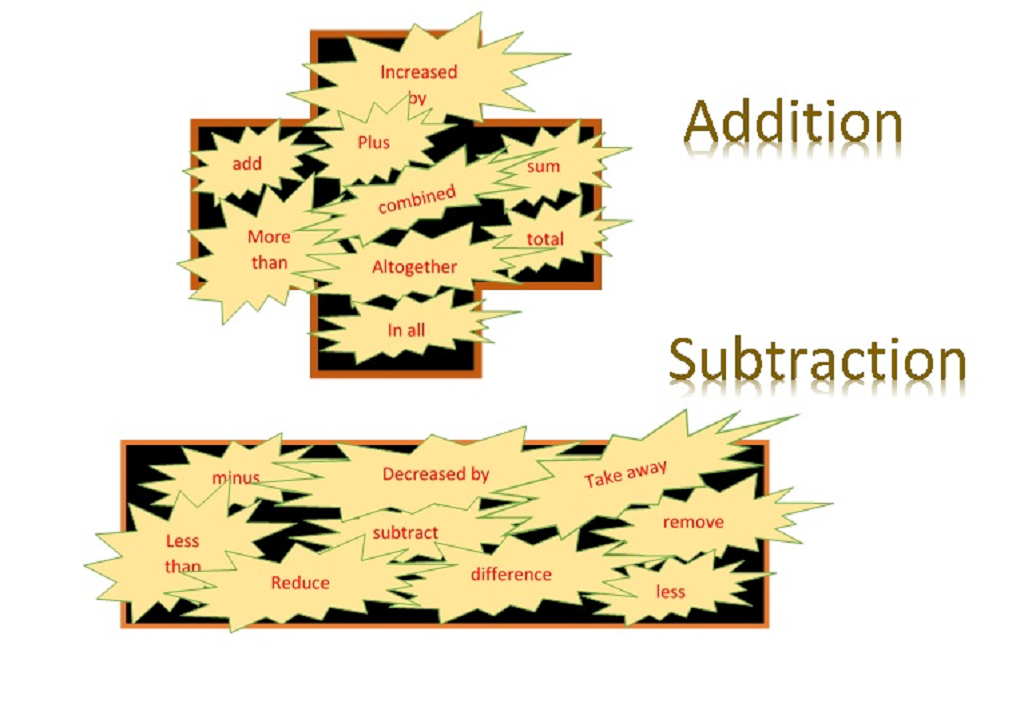
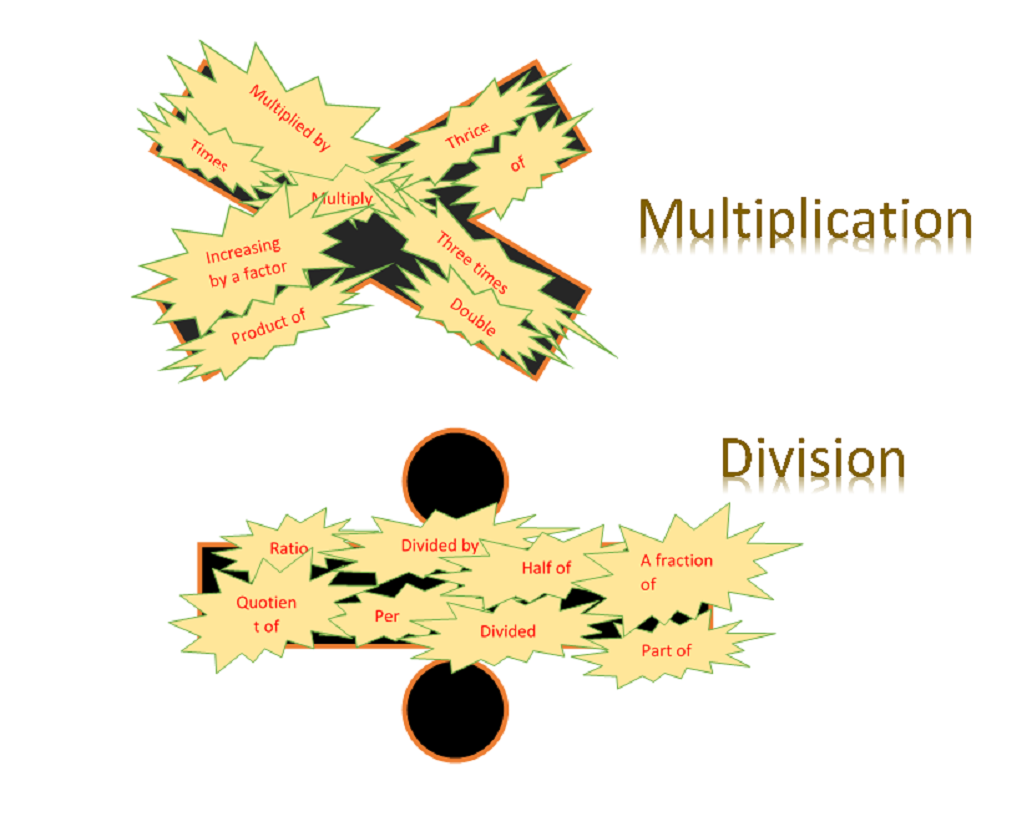
Worksheet to test your understanding of the above concept:
The above worksheet would have given you lots of confidence in using mathematical symbols corresponding to words.
Happy Learning!
↑ Back to topUnit III – Algebraic Expressions: Like terms in multi variable expressions
In this unit, you will be dealing with situations where two or more different variables are involved. (By now, you should be able to understand when some one directly mentions the word ‘variables’!!)
For this, you have an investigation type of activity. In this activity, you will answer the questions one by one and as you go on, you will be getting an idea of how to deal with algebraic expressions with more than one variable.
If you or your teacher need assistance in answering the questions in this activity, then click on the teacher’s version document above.
Note: Before you answer the Try These part of the above Activity, it is recommended that you do the activity presented in this interactive PowerPoint presentation: Algebra like terms
After completing the above activity on like terms, you would have understood how to collect and simplify like terms.
Happy Learning!
↑ Back to topUnit IV – Algebraic Expression: Finding the value of an expression
Let’s go back to our old example in the video above. You have found the total number of students for each value of ‘n’ in the expression – and this is called the ‘value of the expression’!
So, if we have an expression: 3x+4s and if we are given that x=2 and s=3, then the value of 3x+4s would be 3\times2+4\times3=18.
What we did was ‘substitute’ (meaning plug in) the values of x and s in the expression and do the mathematics.
Hence the value of 3x+4s when x=2 and s=3 is 18!
Let’s see if you have understood:
Question: Find the value of 4t-3p given that t=2 and p=4.
Answer: We need to plug in 2 for t and 4 for p in the given expression 4t-3p
Hence the value of 4t-3p when t=2 and p=4 is -4.
Now try the following questions
Find the value of the following expression with the given conditions:
- 2x+8y given that x=3 and y=1
- 4x-3y given that x=5 and y=3
- 8k-4r given that k=3 and r=2
- 5m+4n given that m=-1 and n=3
- 9-3f given f=2
- 8y-3a+10 given that y=-2 and a=\frac12
- 3(x+2)-4(x-3) given that x=5
- (a-3b) imes(2a+4b) where a=-2 and b=-1
Solution
- 2\times3+8\times1=6+8=14
- 4\times5-3\times3=20-9=11
- 8\times3-4\times2=24-8=16
- 5\times-1+4\times3=-5+12=7
- 9-3\times2=9-6=3
- (8\times-2)-\left(3\times\frac12\right)+10=-16-1.5+10=-7.5
- 3(5+2)-4(5-3)=3\times7-4\times2=21-8=13
- (-2-3(-1))\times(2(-2)+4(-1))=(-2+3)\times(-4-4)=1\times-8=-8
Happy Learning!
↑ Back to topUnit V – Algebraic Expression – Simplifying
What is meant by simplifying expressions? Why do we have to simplify it?
Consider an expression
You would have noticed that the variables x and y are repeated in all the terms and you would have probably thought that this expression could be just written as one term in x and another in y alone, maybe with one constant term, after collecting like terms.
So, the expression would actually look like this:
And this is in the simplest form!
In order to simplify algebraic expressions, we use the three properties of real number – commutative, associative and distributive properties.
Click on this link to learn about these properties on real numbers [coming soon!]
Consider the expressions 2+x and xy. Using the commutative property, we can say that this is same as x+2 and yx, respectively. How is this useful in simplifying expressions?
Let’s consider the expressions:
- 3xy+2yx which can be rewritten as 3xy+2xy (since xy=yx) and then we notice that they are like terms which can be added to give 5xy.
- -x+y can be rewritten as y-x to look better with a positive coefficient in the first term.
Consider the expression (x+y)+2y.
Now we have one y in the bracket and another outside. It would be better to use associative property and change the bracket like this:
so that we can add the like terms of y to get x+3y as final simplified expression.
Now consider an expression 2(x+1)+3x.
Here the first x has to be multiplied with 2 before adding to 3x. Hence we used distributive property on 2(x+1) and change it to 2x+2.
So the expression becomes 2x+2+3x.
Now using commutative property to bring the like terms (2x and 3x) together, we can rewrite it as 2x+3x+2 to give the final simplified expression as 5x+2
Identify the properties
Identify the properties used in each step of the following simplification processes. Give reasons for using the property in each case.
- 3x+y=y+3x
- 3(x-2)=3x-6
- (4x+3y)-y=4x+(3y-y)=4x+2y
- (3x-y)+x=(-y+3x)+x=-y+(3x+x)=-y+4x=4x-y
- 2(a-b)+3(a+b+2)=2a-2b+3a+3b+6=2a-2b+3b+3a+6=2a+b+3a+6=b+2a+3a+6=b+5a+6=5a+b+6
Solution
1.
2.
3.
4.
5.
To simplify an algebraic expression, we need to use combinations of the above properties, multiple times in order to get the most simplified form of the expression. By most simplified, we mean that the expression should not have more than one term with same variable(s) and should not have more than one constant term, i.e., there should not be like terms.
Try to simplify the following expressions
- 2(x-6)
- 3x+(2-x)
- 5(x-2)+3(x-3)
- 8a-2b+3(3a-4b)+3+a
- 4m+(3n+8m+1)
- 5uv-u(3v+1)-3(u+2)
- 9x(x+3)+3x^2-2(x+3)
- \frac12(4x)+6\left(\frac x2+1\right)
Solution
Simplified form of the above expressions:
- 2x-12
- 2x+2
- 8x-19
- 18a-14b+3
- 12m+3n+1
- 2uv-4u-6
- 12x^2+25x-6
- 5x+6
Generally, we follow certain rules while giving the final simplified form of the expression:
- The terms are arranged in alphabetical order. For example the term 3x comes before 2z, 4y is written before 3t etc.
- The coefficient is always written before the variable. For example, it is 5y and not y5.
- The term with the highest degree (the power of the variable) is written first and continued with decreasing power of the variable(s). For example: 3x^3+2x^2-3x+4 is the correct format as it starts with the cube of x, then square of x and continues to just x and constant (which is actually x^0). If you have more than one variable, use both the third and first property – highest powers along with alphabetical order. For example: 3a^4-2a^3+3y^3-3x^2+5a-9 is the right order.